Friday, June 29, 2012

Attaching the Neck

Before attaching the neck I had one small detail to finish on the neck. I wanted a small end cap of rosewood on the heel of the neck to help with the transition of the neck to the back of the guitar. I cut a small piece of rosewood and resawed it on the bandsaw to approximately 1/8" thickness. I roughly shaped it to the heel and glued it on to the heel. I secured it with a bar clamp and let it thoroughly dry. After the glue had dried I continued to shape with a rasp and then sanded it to fit.
Gluing and clamping the heelcap.

The heelcap in postion.

In an earlier post I stated that I attached the neck to see if it fit and aligned properly. I could have permanently attached the neck at that point but that would have meant that all of the fret work would have to be done on the neck while attached to the body of the guitar. Many luthiers do the fret work after the neck is attached but that means special care must be used when installing the frets over the body. I decided that it would be easier to work on the frets while the neck was still off the body. Some luthiers even install the frets in the fret board before installing the fretboard to the neck. I don't think any one method is any better than another but keeping the neck separate until all the frets were in place seemed the most logical to me. Now that the neck is complete it is time to attach it to the body. I again tried a dry fit to make sure everything fit and aligned properly. I was now ready to glue and attach the neck. I cut two small piece of wood the same width as the neck to use as a cauls on the top and under the sound board. These cauls would protect the neck and the soundboard from the clamps. I applied white glue to the under side of the fingerboard and carefully attached the neck to the body. Going through the sound hole I inserted the two bolts and tightened them with an allen wrench. I used two C clamps through the sound hole and one bar clamp on the outside to apply even pressure while the glue dried. I also used one bar clamp on the heel and the bottom of the body to pull the neck tight on the top of the guitar.
Gluing and clamping the neck to the body.

2 C clamps through the soundhole.
I allowed the glue to dry overnight before removing the clamps. White glue was used because it is a little easier to remove with heat if the neck ever has to be removed for repairs.

Fret'n About Fretting

In a previous post I talked about the difficulty in preparing the fret board, particularly the accuracy necessary in the fret slot positions. I was now ready to actually install the frets. I had stalled as long as I could and now I really had to jump in and do it. The first step for me was to prepare the fret wire. The fret wire that I had ordered came in straight lengths two feet long. This fret wire needed to be bent to a curve shape that matched the radius of the fret board. I researched lots of methods for bending and looked at several special fret bending tools. I thought about building a fret bending machine from plans that I got from the internet but finally decided to take a much more simple approach on this guitar. I read several articles that stated that you could effectively bend the wire by pulling it down over an edge of hard wood. The effect is similar to curling ribbon by pulling it against the edge of a pair of scissors. I started by filing a v groove in the edge of a piece of 1x4 lumber. This groove was for the tang of the fret wire to slide through and help guide the wire as I pulled it down and over the edge. I used the wooden handle of a dust brush to hold the wire down as I pulled it through the slot. This method seemed to work pretty well, although the starting end needed a little attention as it remained flat. This method puts a nice arc on the wire but there is no real method of getting the radius exact. I think when I build my next guitar I will go ahead and spend some time and make a bending tool but this method was certainly quick and easy and it seemed to work fine.
Inserting the tang in the v groove.

Using the wooden handle to hold the wire in position.

Pulling the wire through the slot to create the curve.
The next step was cutting the wire to length. I cut the wire long to allow about 1/8 inch overhang on each end.
Measuring wire with the fret slot.

Cutting the wire.
I used a little water and a drop of white glue to help set the wire in the slot. I used a small plastic palette knife to drop and spread the water into the slot. I then used my specialized glue spreading tool to apply a small amount of white glue to the tang of the fret wire.
Spreading water into the slot.

Applying glue to the tang of the fret wire.
I then carefully positioned the wire in the slot making sure the tang was square and in position in the slot. I seated the wire on one side with the fret hammer and worked my way across the face of the wire to the opposite side. After a few times I could easily see, feel and hear the fret as it seated properly.
Positioning the wire in the slot.

Tapping the wire into the slot with the fret hammer.

Working my way across the slot.
After I was sure the wire was seated properly I cleaned up all the glue with a wet sponge and trimmed the excess wire overhang. A good pair of fret wire cutters makes this part easy and saves a lot of excess filing later.
Cleaning up excess glue.

Trimming wire overhang.
As it turned out all my "fret'n" was for not and the fretting process was one of the easier parts of this long journey.
Finished neck with installed frets

Finished fret installation.

Tools
After the frets are successfully installed, they still need some finish work. The edges must be filed and polished and the entire fretboard must be leveled. The ends of each fret are burred by the cutting process and must be filed flat and then beveled for smooth playing. You can do this with a standard metal file but I decided to make a simple file holder to make this process more uniform. I started by cutting two pieces of maple 3"x8"x1.25". I cut a straight 90 degree slot approximately 1/2" from one edge and approximately 5/8" deep. This slot will hold a file, allowing it to stick up about 5/8" above the block. This file block can now be used to run on top of the frets with the file running along the edge filing the frets back to a flush 90 degrees. The other block I cut a similar slot to hold the file but I angled the blade so I cut a 35 degree slot to bevel the frets back and soften the edge.
Maple blocks with 90 degree and 35 degree slots.

Blocks and file.

File inserted into angle slot.
After the edges of the frets were filed smooth the bottom of the slots need to be filled. Thick CA glue was used for this then sanded smooth.
CA glue and fret board.

Filled slots.
The final step was leveling the frets, then filing and finally polishing with steel wool.I used a fret leveling file and the radius block to apply the same radius that was used on the finger board to the frets. Each fret was then reshaped with a fret file and then polished with 0000 steel wool.
Finished fret board and fretting tools.

Thursday, June 28, 2012

Summer 2012

My last post was way back in April. Well, summer is finally here and with summer comes a welcome break from my day job as a Design Educator. For the past twenty plus years I have taught at least one class during summer school. This year the class that I was scheduled to teach didn't have enough enrollment to make, so, I guess I get the summer off. My plan was to finish the guitar and spend some time doing some things that I want to do. I am sure there will be plenty of things to keep me more than busy all summer long.

Back to the guitar and my progress. It is now late June and I have been working fairly steady on the guitar. I started by gluing the head veneer on the head and working on the decorative inlay. I decided to use a piece of the flamed maple that I used for the sides as the head veneer. The entire neck, including the head is maple. The back of the guitar is also maple with a small strip of rosewood down the center. The sides are also maple but they are curly/flamed. This gives the sides an extremely interesting grain pattern. I want the entire guitar to be light in color including the head so I chose a piece of curly maple for the head veneer. To add just a touch of color and to help tie the rosewood strip on the back and the rosewood fingerboard to the guitar color scheme, I also sandwiched a very thin piece of mahogany veneer between the head stock and the curly maple head veneer. This left a hairline stripe around the guitar head edge. I decided to use a version of my graphic design company logo (The Hefner Group) as the head inlay.
The Hefner Group logo.
 The first step was to cut the head veneers and glue them in place.
Clamping the head veneers in position using a clamping caul.

A variety of c-clamps were used to give even pressure.

Six clamps and a caul on the top and the bottom were used.
After the glue set up, I removed the clamps and trimmed and sanded the veneers flush with the head stock. My original idea was to inlay the logo using small squares of mahogany veneer leaving a hairline gap between each square that I would fill with black epoxy to create an outline effect. Nice plan but my inexperience with this kind of detail proved to be to big of an obstacle for me to overcome.
As you can see, I had trouble getting consistent gaps between the shapes.

After several tries I decided to try something a little different. I had worked with laser engraving on other projects and I knew I could get a beautiful engraving of the logo on the mahogany. It should then be much easier inlaying one piece. First I had to rout out all of the pieces from previous attempts. I created a simple template using the edges of my Dremel precision router base as guides.
Thin strips of oak were tacked down to act as guides.

Depth of cut was set to the thickness of the veneer.

Veneer was carefully removed leaving a square recess for the laser engraved logo.
A little attention to the corners with a small chisel and I was ready to cut and insert the engraved logo.
The final inlay.
The engraved logo looked great and the mahogany was the right color but the grain was to pronounced. I ended up using thick CA (super) glue as a grain filler. Several coats were applied and scraped off until I got a smooth surface texture that matched the maple.

Monday, April 2, 2012

Fitting The Neck and Body Together

 After radiusing and sanding the fingerboard top down to 320 grit sandpaper I was able to finish shaping the neck. At this point I needed to see if the neck was going to fit on the body. I inserted the barrel nuts into the neck and positioned them as close to straight as possible. I then slid the tenon on the neck and into the mortise cut in the body of the guitar. I was able to insert the allen wrench for the bolts through the sound hole and through the hole in the under brace that I had drilled early in the construction. I then inserted the wrench into the truss rod in the neck and slowly guided it into place in the mortise slot. I then inserted the two bolts through the sound hole and into the barrel nuts in the neck joint. I tightened them by hand then using the allen wrench, I tightened them to pull and seat the neck firmly into the mortise in the body. AMAZING it fit! It even looks straight. It finally looks like a guitar. Another one of those a-ha moments. I really think it's going to be a guitar!
Finally it looks like a guitar!


The Neck Joint

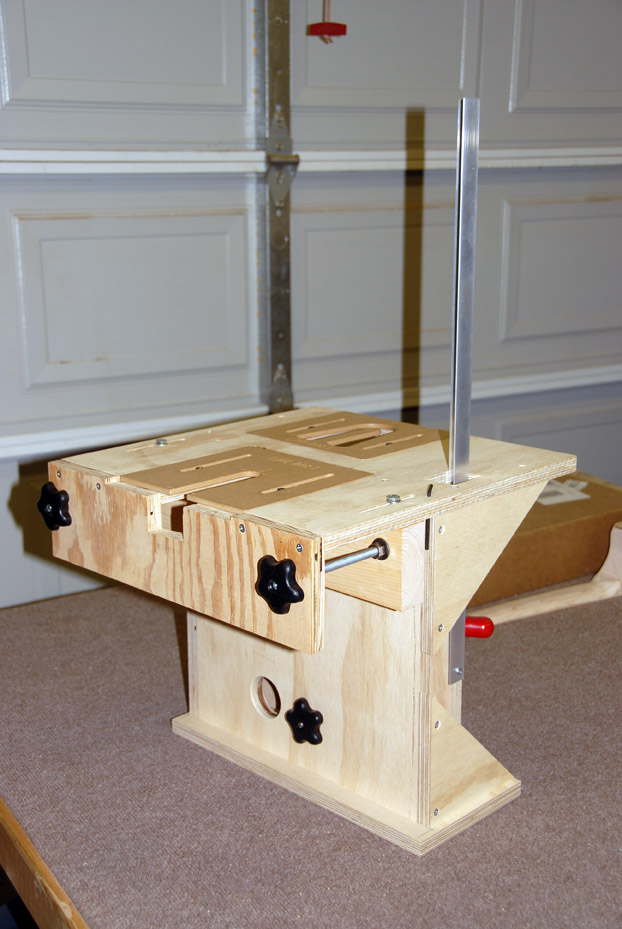
When I first started this guitar I decided to use a traditional dovetail joint to attach the neck to the body. I thought that was the preferred joint and the type that Martin Guitars used. If it was good enough for a Martin it should be good enough for me. As I mentioned early on in this blog the first book that I purchased did not match the plans that I was using. One of the biggest discrepancies in the book and the plans was the neck joint. The book advocated a Spanish Heel method of attaching the neck. This method does away with the traditional joint and attaches the neck to the soundboard by gluing before the body is closed. Since I had never heard of this method and what minimal research I had done at this point indicated this method was usually used in classical guitar construction I decided to buy a new book. I then started researching different types of neck joints. I discovered that more and more luthiers were going to the bolt on mortise and tenon neck rather than the dovetail. I found one article that said even Martin had started building their guitars with bolt on necks. It did seem to be easier and once again if it was good enough for Martin it was good enough for me, so I decided to go with that method. The more I researched the more convinced I was but it appeared that the joint was going to be more critical than I had first thought. Keeping the joint straight and at the right angle for proper string height seemed to be so critical that I would need some sort of jig/template to get it right. I did internet research, watched youtube videos and looked at luthier supply catalogs. As with all the other problems I encountered there were many solutions. Some very simple and home made others relatively expensive. I decided that a jig designed by Robert O'Brian and distributed by Luthiers Mercantile International (LMI) was the best bet. So, I dug in my pockets one more time and ordered the kit and instructions. The kit supplied the instructions and parts, I had to supply the wood. It took me several days to build (remember I am part time, and slow.) I am very satisfied with the end result, a very nice and sturdy jig to route the mortise and the tenon.
Finished jig.


Finished jig.


Jig clamped to table showing neck clamped in position.

Body clamped in position.

Body ready to route mortise.

Plunge router set for mortise.

Mortise template

Finished mortise.

Neck set to route tenon.

Router in position.

Tenon template.
Finished mortise and tenon.